
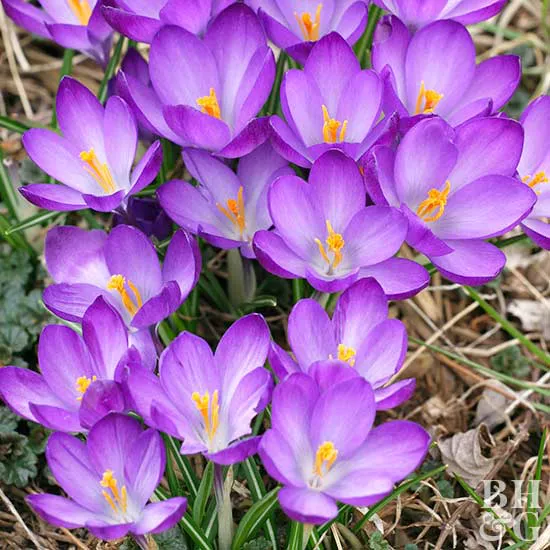
Crocus brings early spring color to the landscape by popping out of the ground (sometimes through snow!) with petite, ground-hugging flowers. Large sections of crocus planted beneath deciduous trees create a spectacular sight. This plant also possesses the power to jazz up rock gardens, brighten the ground in front of shrubs, and line sidewalks with splashes of color.
Spring and fall crocuses are toxic to pets.
Crocus Overview
| Genus Name | Crocus |
| Common Name | Crocus |
| Plant Type | Bulb |
| Light | Part Sun, Sun |
| Height | 3 to 6 inches |
| Width | 1 to 3 inches |
| Flower Color | Blue, Pink, Purple, Red, White, Yellow |
| Foliage Color | Chartreuse/Gold |
| Season Features | Fall Bloom, Spring Bloom |
| Special Features | Fragrance, Good for Containers, Low Maintenance |
| Zones | 3, 4, 5, 6, 7, 8 |
| Propagation | Division |
| Problem Solvers | Deer Resistant, Drought Tolerant, Groundcover |
Where to Plant Crocus
Plant crocuses in a location with full sun or partial shade. Don't shy away from planting them under deciduous trees, beneath shrubs, or around the bases of perennial plants. The crocus will complete its life cycle before larger plants leaf out and limit its sunlight. Plus, trees offer growing conditions favorable to this plant beneath their canopies: drier soil and less dense grass than found in open areas of lawn. This is also the best location to create a tapestry effect with a mass planting because there is limited competition from lawn grass.
The location should have well-drained soil with a neutral pH (6.0 to 7.0).
How and When to Plant Crocus
Crocus has corms, which are similar to bulbs but without the layers. The corms should be planted in fall as soon as the soil has cooled down to about 55 degrees F.
The spacing depends on the type of crocus. Plant the corms 2 to 4 inches deep and 2 to 4 inches apart with their pointed tips facing up. The corms of species crocus, or botanical crocus (Crocus chrysanthus) are smaller and are planted closer together than giant crocus (Crocus vernus). Water them well after planting.
Crocus Care Tips
Light
Crocus can grow in full sun or partial shade.
Soil and Water
Crocus bulbs grow best in well-drained and even slightly dry soil. Poor drainage and soggy soil is problematic. If you have clay soil, add soil amendments. Mix sand, peat moss, and well-aged compost with a neutral pH into the soil at planting time.
Crocuses usually don’t need watering, as their growth period is during a time of sufficient natural precipitation in the late winter and early spring.
Temperature and Humidity
Crocuses are hardy perennials that can be grown down to zone 3. Summers above zone 8 are too hot and winters too mild to grow them. By the time the weather turns humid, crocuses have entered their summer dormancy so they are not affected by humid weather.
Fertilizer
Generally, crocuses don’t need a lot of fertilizer but they benefit from a balanced complete fertilizer after planting (never added to the planting hole but scattered afterwards), then again in the spring as soon as their sprouts emerge, and a third time after the bloom when they die back.
Pruning
After the crocus blooms, allow the foliage to remain in the garden or lawn until it turns completely yellow. During this time foliage produces nutrients that sustain the bulb for the next growing season. Delay mowing a lawn embedded with crocus until the plant's foliage turns fully yellow. In some areas, this means delaying the first lawn mowing until mid- to late June.
Potting and Repotting Crocus
Crocuses are not suitable for growing in containers. The corms need consistently cold winter temperatures to develop good root systems and grow foliage and flowers in the spring. In containers, unlike in garden soil, they are exposed to temperature fluctuations and cycles of freezing and thawing, regardless of the size of the container.
Pests and Problems
Squirrels and chipmunks are the biggest danger to crocuses; these critters are ready to dig in as soon as you have planted your crocuses. One option is to plant a lot of crocuses to beat their appetite. You can also plant the crocuses as late as possible in the fall, just before the ground freezes, to decrease the chance of critters digging up the corms. Another option is to cover the planting area with fine chicken wire or hardware cloth after planting and remove it in the spring when the crocuses start to sprout.
How to Propagate Crocus
Crocuses are best propagated by division when they are getting too crowded. This can be done every three to four years, or as needed. As crocuses die back after their bloom, mark the location so you know where to dig them in the fall. Using a shovel, dig up the corms, which may range in size from large to tiny offsets. All of the corms can be planted except bruised, dead, and diseased corms, which should be discarded. Transplant the corms in a new location as described above.
Types of Crocus
'Bowles White' Crocus
This variety of Crocus sieberi bears snowy, chalice-shaped flowers with deep yellow throats that appear in early spring. It grows 2–3 inches tall. Zones 3–8
'Firefly' Crocus
Lilac blooms that sport yellow throats and appear abundantly in late winter and early spring make this variety of Crocus sieberi unique. The plant grows 2 to 3 inches tall. Zones 3–8
'Flower Record' Crocus
Crocus vernus 'Flower Record' produces large goblet-shaped pale violet blooms that open above grasslike foliage. It grows 4 to 5 inches tall. Zones 3–8
'Golden Yellow' Crocus
This variety of Crocus x luteus produces grasslike leaves and cup-like yellow to yellow-orange flowers with olive-green striping on the outside. Zones 3–8
'Goldilocks' Crocus
Crocus chrysanthus 'Goldilocks' is an early-blooming variety that has bright golden-yellow flowers. It grows 2–3 inches tall. Zones 3–8
'Jeanne d'Arc' Crocus
Also known as spring crocus, Crocus vernus 'Jeanne d'Arc' has cup-like white flowers with small purple bases and bright orange pistils. Zones 3–8
'Lilac Beauty' Crocus
Crocus tommasinianus 'Lilac Beauty' offers lilac-blue flowers that gradually open to reveal showy, divided gold stamens. It flowers abundantly in early spring on plants that grow 2 inches tall. Zones 3–8
'Pickwick' Crocus
This large-flower variety of Crocus vernus 'Pickwick' has silvery lilac-striped blooms that appear abundantly in early spring. It grows 4 inches tall. Zones 3–9
'Tricolor' Crocus
Crocus sieberi 'Tricolor' has fragrant lilac-blue flowers illuminated at the base by broad yellow and white bands. Zones 4–8
'Yellow Mammoth' Crocus
Crocus vernus 'Yellow Mammoth' offers gigantic golden-yellow blooms that pop up in early spring and naturalize easily to spread a layer of sunshine under bare trees and shrubs. It grows 5 inches tall. Zones 3–8
Fall Crocus
Crocus speciosus lives up to its name, producing blue flowers in October. Unlike spring crocuses, it is planted in the summer. It grows 4–6 inches tall. Zones 3–8
Garden Plans for Crocus
Because crocuses are small, they fit especially well in rock gardens. Check out these ideas for rock gardens.