
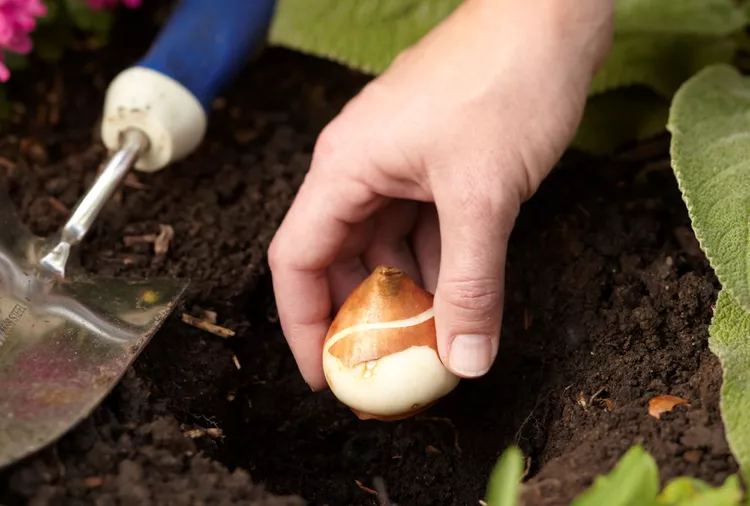
How and when to plant tulip bulbs can seem confusing to beginning gardeners. Should you plant them in fall or can you plant tulip bulbs in spring? How deep do they need to be? Can you plant the bulbs in pots? The following planting guide answers all these questions and more. Whether you choose tulips with single or double flowers, fringed flowers, or even varieties that don’t look like typical tulips, these spring-blooming bulbs are easy to plant and grow.
When to Plant Tulip Bulbs
Autumn is the best time to plant tulips, but the arrival of that season varies significantly across the U.S. In general, northern gardeners plant bulbs outdoors in September and October, while southern gardeners plant them outdoors in November and December.
Aim to have the bulbs in the ground about six weeks before the ground freezes or the first hard frost in your area. As a rule of thumb, it is time to plant tulips in the fall when nighttime temperatures are consistently in the 40s.
Types of Tulip Bulbs
Most tulip vendors ship in early fall, and the most popular varieties sell out quickly, so don’t wait to place your order. Selecting tulip bulbs can feel like information overload. Here are a few ways to sort them out when preparing a fall order.
- Bloom season: Tulip bulbs are usually classified as early, mid, or late season. The exact bloom dates will differ based on your climate, but planting some of each gives you an extended display of beautiful spring flowers.
- Size: Tulip bulbs come in a variety of sizes. In general, larger bulbs produce larger plants and fetch a premium price.
- Prechilled: Tulips need about 12 weeks of cool temperatures, called chilling, to be ready to bloom. Many gardeners achieve that by planting the bulb outside in the fall and letting Mother Nature take care of it. Southern gardeners in USDA Zone 7b or warmer may need to buy prechilled bulbs, meaning the vendor has kept them in a cooler for several months to satisfy the bulbs’ chilling requirements.
Preparing the Soil
Soil needs for growing tulips in the ground and in pots are similar. Good drainage is essential–soggy soil can cause bulbs to rot. When planting in containers, use a high-quality potting mix and a pot with adequate drainage holes.
Terra-cotta pots look great with tulips and help regulate soil moisture levels.
Planting tulips in the ground requires preparation. New beds should be dug or loosened to a depth of 12 inches for larger bulbed varieties. Work in compost to provide organic matter and improve soil structure. Planting tulip bulbs in raised beds can reduce the work involved in digging deep beds.
Planting Depth for Tulip Bulbs
Tulip bulbs need to be buried deep. Tulip bulb sizes vary, so instead of using a measuring tape, strive to plant tulips about three times as deep as their size. A 2-inch diameter bulb would be planted 6 inches deep; a miniature 1-inch bulb only about 3 inches down. Measure from the bottom of the bulb.
Tulips can be spaced closely. Flower farmers pack them in shoulder to shoulder. For the home gardener, a spacing of two times the size of the bulb provides excellent results—so leave 4 inches between 2-inch bulbs.
Tulips planted in pots can be spaced more closely together than in outdoor beds to provide a container bursting with color.
Planting Tools and Techniques
Because tulips must be planted deep, you may want to invest in a bulb planter if you have more than a few. Hand-operated planters, larger stand-up models, and even augurs for cordless drills are all good options. A hand trowel works fine if you only have a few to plant.
Tulip bulbs have a definite “up” and a “down.” When planting tulips, put the bulbs in the hole pointy end up. Placing them in the hole correctly gives them the best chance of success.
If you're planting a bunch of tulips, dig a trench and place the bulbs. Then, fill the trench with the removed soil.
Water and Fertilizer Needs
Tulips are bulbs, so frequent watering and wet soil can cause problems. Water the bulbs well immediately after planting them in the autumn, and then don’t water them again until spring in most climates. However, long dry spells or arid climates may need additional water in the fall. After foliage appears in the spring, water once every week or two if it hasn’t rained.
Fertilize tulips when planting in the fall by adding a handful of compost and about a tablespoon of bonemeal to the hole. After the bulbs sprout in spring, feed them again with bone meal and compost or a slow-release, all-purpose fertilizer.
Tulips that are dug up and composted after blooming don’t need spring fertilization.
Protecting Tulip Bulbs
Mice, chipmunks, voles, and other critters find tulip bulbs tasty and nutritious. If you’ve had problems with rodents eating your bulbs, here are a few ideas to try:
- Mix tulips with other bulbs. Rodents don’t like daffodils, alliums, and fritillaria.
- Sprinkle repellents in the hole when planting.
- Crushed gravel or sharp material, such as crushed oyster shells, can deter tunneling rodents.
- Construct or purchase wire cages and plant the bulbs inside.