
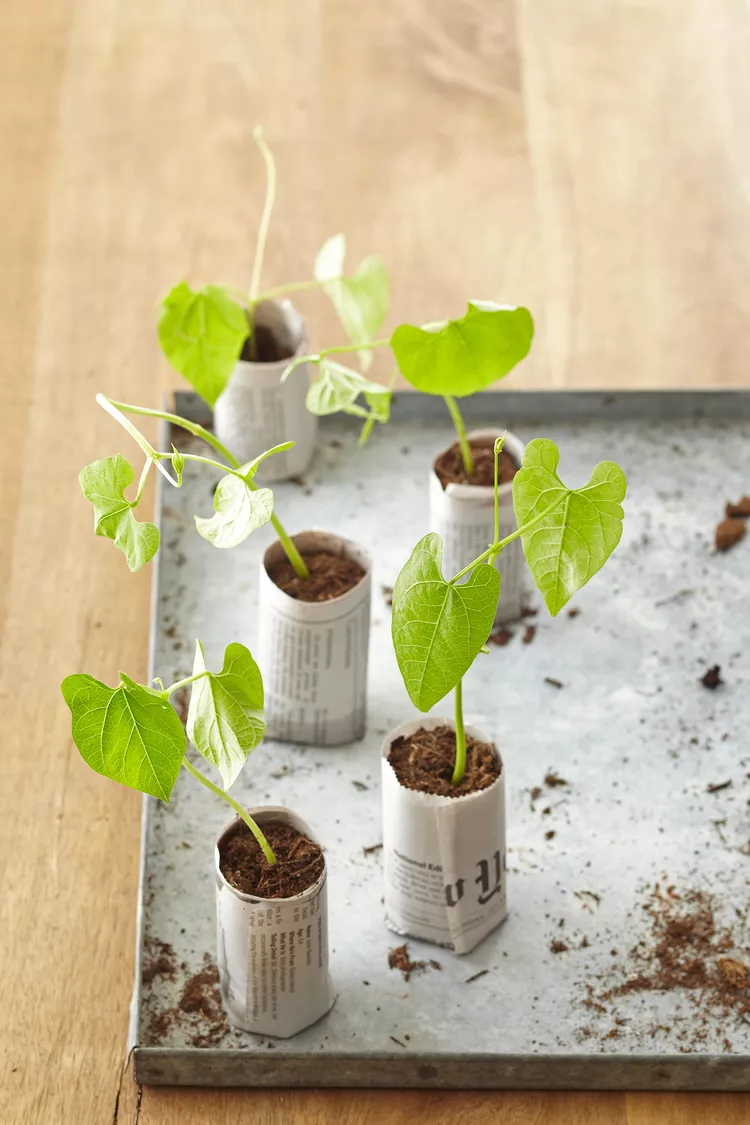
Getting a head start on the growing season is easy to do by planting a few seeds indoors in the winter. Most seeds aren't too picky about what they grow in, as long as they get enough warmth, moisture, and sunlight. While there are plenty of containers you can purchase made specifically for starting seeds, you can save a little cash by making your own out of items that are likely already in your recycling bin. Newspaper, paper towel rolls, small boxes, and shredded paper can all be easily transformed into biodegradable seed pots. Follow our step-by-step instructions and you'll soon have plenty of pots for growing all the seedlings you want.
Check the seed packet to help you figure out when to sow your seeds in your DIY pots. Usually, it'll be about six to eight weeks before the average last frost date in your area (so if that's April 15, count back from then and make sure you start your seeds on or after March 18). Once your seeds have sprouted, make sure to provide them with as much sunlight as possible (or use grow lights). When the weather outside has warmed up and there's no threat of frost, it's time to harden off your seedlings, which means slowly getting them used to outdoor life by placing them—pots and all—in a protected spot in your yard for an hour or two and gradually lengthening that time until they can stay outside all day. At that point, they should be strong enough to transplant into your garden beds or porch pots.
Newspaper Pots
Finished with the Sunday paper? Now you can turn it into handy little pots for your seeds. While you're rummaging in your recycling bin, fish out any small glass jars to serve as a mold—a juice glass with straight sides will do just as well if you don't have any jars.
Supplies Required
- Small glass jar
- Newspaper
- Scissors
- Shallow pan with water
- Seed starter potting mix
- Seeds
Step 1: Cut Newspaper
Cut newspaper into rectangles that are large enough to wrap all the way around the jar with a little overlap.
Step 2: Soak Newspaper
Submerge the newspaper in a shallow pan of water until moistened.
Step 3: Shape Pots
Roll the softened paper around the jar. Extend the bottom edge of the paper enough to fold and form the pot's bottom. Crimp and press the paper around the bottom of the jar. Flatten the bottom by pressing it on a flat surface and set aside to dry. Carefully slide the paper pot off the jar once dry.
Step 4: Plant Seeds
Fill your new paper pots with seed starter mix and lightly pat down the soil. In the center of each pot, create a shallow hole in the soil with your finger or the end of a pencil. Place the seed in the hole and cover it with soil. Spritz the pots with enough water to completely moisten the soil.
Upcycled Box Seed Starter
Lots of household items come in small paper boxes that are just the right size to hold seeds—and sturdy enough to hold together until the resulting seedlings can be planted outside. Give new life to the boxes that once held pantry staples like tea bags by turning them into seed trays for sprouting several seeds together.
Supplies Required
- Small paper box, such as a tea box
- Scissors
- Seed starter potting mix
- Seeds
Step 1: Cut Boxes
Use scissors to cut one of the longer sides off the box to form a shallow tray.
Step 2: Make Dividers
Use the remaining cut pieces to create dividers as needed.
Step 3: Plant Seeds
Fill each box with seed starter mix and lightly pat down the soil. Create a shallow hole in the soil with your finger or the end of a pencil in each section. Add a seed to the holes and cover them with soil. Spritz the homemade seedling tray with water until the soil is completely moistened.
Paper Towel Tube Pots
As useful as paper towels are around the house, the leftover tubes can be just as versatile for DIY projects like these biodegradable seed planters. Just make a few snips, fold in one end, and you're done.
Supplies Required
- Paper towel tubes
- Scissors
- Seed starter potting mix
- Seeds
Step 1: Cut Tube
Cut the paper towel tube into three-inch sections. At one end of each section, make four evenly spaced cuts approximately ¾-inch long to form the flaps that will close across the bottom of the pot.
Step 2: Fold Flaps
Fold in each flap to close one end of the tube section. It's okay if there is a small gap between the flaps—it will help with drainage.
Step 3: Plant Seeds
Fill your new tube pots with seed starting mix. In the center of each pot, create a shallow hole in the soil with your finger or the end of a pencil. Place a seed in the hole and cover it with soil. Spritz the soil in each pot with water until it is completely moistened.
Papier-Mâché Pots
A little heat helps make these DIY containers extra sturdy. The process starts out similarly to other handmade paper projects, but then you stir in a little flour and bake after forming it into pot shapes.
Supplies Required
- Shredded paper (newspaper works well)
- Fine mesh strainer
- Flour
- Water
- Muffin tin
Step 1: Blend Paper Shreds
Fill your blender with shredded paper and completely cover with water. Let the shredded paper sit in the water for five minutes to soften. Blend until the paper has a smooth consistency. Start heating your oven to 200 degrees.
Step 2: Strain Paper Mixture
Pour the blended paper into a mesh strainer over a bowl. Press the paper in the strainer with a sponge until the paper mixture has a wet clay-like consistency.
Step 3: Form Pots
Place the paper mixture into a clean bowl and add about 2 tablespoons of flour. Use your hands to combine the flour and paper until you have an even consistency. Place small balls of this clay-like mixture into muffin pans and press it onto the bottom and sides of each cup as thin as possible. Repeat until you use up all the mix.
Step 4: Dry Pots
Bake in the oven for one hour. The pots will not be completely dry when you take them out; the oven just accelerates the drying process. Once the pots are cool, remove them from the muffin pan and place on a cooling rack. Allow to finish drying overnight.
Step 5: Plant Seeds
Fill your papier-mâché pots with seed starting mix. Poke a shallow hole in the center of the soil in each pot with your finger or the end of a pencil. Place a seed in the holes and cover it with soil. Spritz the pots with water until the soil is completely moistened.