
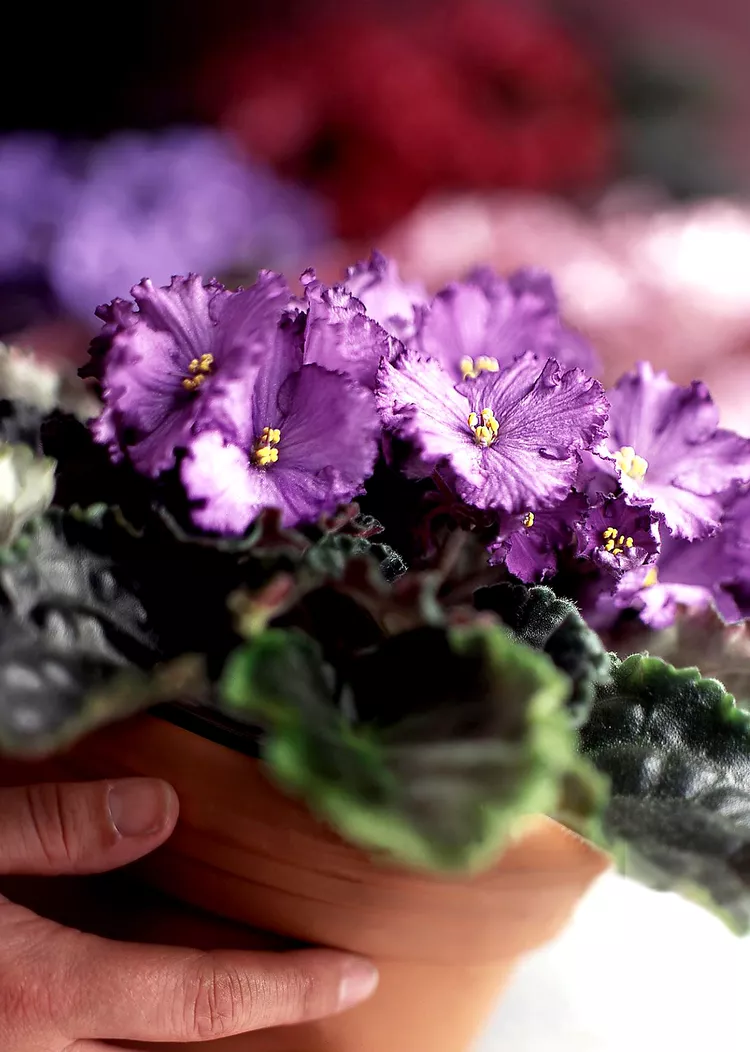
Blooming off and on during the winter months, African violets unfurl pretty flowers in shades of white, pink, red, purple, and blue. Some varieties of these popular houseplants also feature double blooms and ruffled petals. The individual flowers last for a week or more. Count on the plants to be in bloom for about a month before taking a short break and erupting in a profusion of flowers again.
African Violet Overview
| Genus Name | Saintpaulia ionantha |
| Common Name | African Violet |
| Plant Type | Houseplant |
| Light | Part Sun |
| Height | 2 to 6 inches |
| Width | 4 to 16 inches |
| Flower Color | Blue, Pink, Purple, Red, White |
| Foliage Color | Blue/Green |
| Season Features | Fall Bloom, Reblooming, Spring Bloom, Summer Bloom, Winter Bloom |
| Special Features | Low Maintenance |
| Propagation | Leaf Cuttings |
Where to Place African Violets
The ideal place for African violets is an east- or north-facing window where they get bright direct light but only little to no sun. In a window, place the plant twelve to eighteen inches from the glass. Keep them away from heat sources such as radiators where the air is very dry.
African Violet Care Tips
If you provide these plants with the proper growing conditions, African violets will bloom repeatedly with little care.
Light
African violets grow well in bright east- or north-facing windows. Avoid locations where they will receive direct sunlight in the afternoon; too much sun can burn leaves and prevent the plants from blooming. Turn plants weekly to encourage even growth on all sides.
If there is no suitable window, you can also place the plant under grow lights positioned 10 to 12 inches above the plant.
Soil and Water
African violets need a lightweight potting mix with a high amount of perlite, vermiculite, and sphagnum peat moss. You can also purchase a specially formulated African violet potting mix.
The soil should be moderately moist at all times. Plan to water your plants at least once a week in summer and more frequently in winter when the soil tends to dry quickly. Room temperature water is best.
The way you water African violets also matters. Overhead watering methods damage the foliage. When water droplets fall on the fuzzy leaves, they often leave behind ugly brown spots. Instead of watering from above, place pots in a shallow dish filled with about an inch of water. The plants will absorb water from the bottom. A baking pan or flat-bottom soup bowl is perfect for watering African violets. Leave the plants in the water tray for about 30 minutes.
Temperature and Humidity
African violets hail from moist, humid environments. In winter, the air in most homes doesn't have enough moisture for great growth and flowering. You can bump up the humidity around your plants by creating small water reservoirs. Fill a shallow tray, such as a pot saucer, with an inch or two of gravel. Add water to the tray so it is just below the surface of the gravel. Place your African violets right next to the gravel trays. The water will evaporate and humidify the atmosphere around your plants.
Fertilizer
Use a fertilizer specially designed for African violets, which has a high phosphorus content to promote blooming. The nutrient concentrations vary greatly between brands; organic fertilizers typically have lower concentrations. Follow the label directions for frequency and amounts.
Pruning
Remove any fading or shriveled leaves and flowers to encourage the development of more flowers.
Potting and Repotting African Violet
African violets should be potted in a low, shallow planting pot with large drainage holes. Use a high-quality potting mix for indoor plants or African violet potting mix and place the violet in the pot so that the crown is just above the soil line. Water plants thoroughly after potting to promote good contact between the roots and soil.
Generally, African violets grow and bloom best if you repot them about once a year. It's time to repot your plant when you notice excessive loss of lower leaves and lengthening of the central growing point. Choose a pot that is slightly wider than the previous container.
Pests and Problems
Common problems of African violet include powdery mildew, root or crown rot. Thrips are a common pest of African violets. They not only feed on the plants but also transmit a deadly virus called Impatiens Necrotic Spot Virus.
How to Propagate African Violet
African violets can be easily propagated from leaf cuttings. Remove a healthy leaf with a stem of 1 to 2 inches long, cutting the stem at an angle. Fill a 4-inch pot with a moist, porous mix, such as vermiculite and/or perlite, or either one mixed with peat moss.
Fully insert the stem and about ¼ inch of the leaf in it. Cover it with a perforated plastic dome or a zippered plastic bag. Keep the medium moist at all times in a warm location away from direct sunlight. It may take two months for new plantlets to form on the leaf. Repot the new plants in individual pots with suitable potting mix.
Types of African Violet
Benediction African Violet
Saintpaulia ionanatha 'Benediction' bears large ruffled lilac blossoms over scalloped green foliage.
Vermont African Violet
This Saintpaulia ionantha selection blooms in rich, deep purple. Its medium green leaves have reddish petioles and undersides.
Tomahawk African Violet
Saintpaulia ionantha 'Tomahawk' has cherry red blooms and deep green leaves.